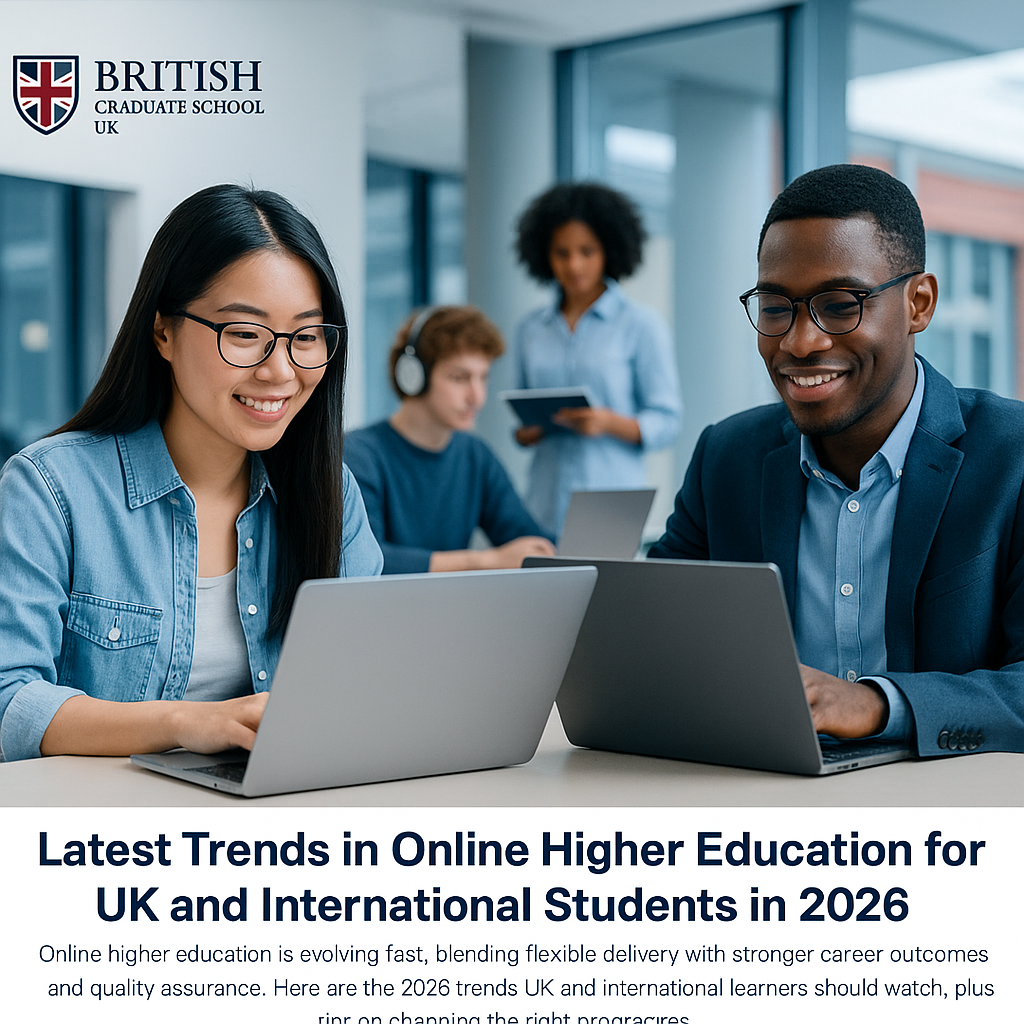
Online higher education has shifted from an emergency response to a mature, high-quality route into globally recognised qualifications. For UK and international students, 2026 brings smarter technology, more flexible study paths, and stronger career alignment, all underpinned by clearer quality standards and better student support. Below are the key trends shaping the landscape and practical advice to help you decide with confidence.
Why online higher education now
- Flexibility without relocation costs and visa constraints for many courses
- Access to UK academic expertise and industry links from anywhere in the world
- Improving student experience through personalised learning and 24 or 7 support
- Stronger employer recognition of online degrees, micro-credentials, and work-integrated projects
Trend 1. Stackable micro-credentials and modular degrees
Micro-credentials are short, credit-bearing courses that target in-demand skills. In the UK, many are now mapped to recognised qualification frameworks and can stack towards postgraduate certificates, diplomas, or full master’s degrees. Expect clearer credit transfer routes, transparent learning outcomes, and employer co-designed syllabi. For busy professionals and career changers, this model reduces risk and cost by letting you progress in stages while signalling capability to employers sooner.
Smart tip: Check that any micro-credential you take is credit-rated and can be applied to a future award at the same or a partner institution. Confirm recognition with your employer or professional body before enrolling.
Trend 2. AI-powered learning that is human-led
Adaptive courseware, AI tutors, and analytics are improving study pathways, feedback timeliness, and early alerts for at-risk students. The best practice is human-in-the-loop: academic staff oversee AI recommendations, and institutions are transparent about data use. You will see clearer policies on responsible AI use in assessments and skills training in AI literacy to boost employability.
Smart tip: Review the institution’s guidance on AI use, data privacy, and academic integrity. Confirm that feedback remains personalised and that tutors are available for escalation when you need a human expert.
Trend 3. HyFlex and blended online delivery
HyFlex combines live sessions, on-demand recordings, and independent study, allowing learners to switch between real-time and asynchronous modes. In 2026, expect more timezone-aware timetabling, shorter live events focused on interaction, and bite-sized video with transcripts and captions. This lowers barriers for working professionals and international students balancing career, caregiving, or military commitments.
Smart tip: Ask for a sample timetable showing live session times in your timezone, plus how many sessions are compulsory and how recordings are handled.
Trend 4. Global collaboration at scale
Cross-border teamwork is now a core feature. Virtual labs, case competitions, and consultancy projects simulate international workplaces, sharpening communication, problem-solving, and intercultural skills. Programmes increasingly assess collaboration explicitly through peer review, project portfolios, and reflective practice.
Smart tip: Look for modules with employer briefs or community impact projects. Evidence from real clients strengthens your CV and LinkedIn profile.
Trend 5. Work-integrated learning and career outcomes
Online does not mean disconnected from industry. Expect more virtual internships, industry mentors, career sprints, and hackathons. Careers services are becoming proactive, with skills mapping, CV and portfolio clinics, and alumni networking that fits global time zones.
Smart tip: Request graduate outcomes data where available. Ask how the programme maps modules to high-demand roles and certifications relevant to your sector.
Trend 6. Authentic assessment over high-stakes exams
Assessment design is shifting toward real-world outputs such as portfolios, design artefacts, data notebooks, and implementation plans. Where exams remain, they are commonly open-book with applied problem sets. Proctoring is more targeted and risk-based, paired with academic integrity education and formative feedback.
Smart tip: Review sample assessments to ensure they align with your job role or desired role. Authentic outputs double as work samples for interviews.
Trend 7. Student support that follows the sun
Online learners now expect and receive 24 or 7 support. Institutions are investing in success coaches, out-of-hours technical help, mental health services, accessible study skills resources, and peer communities. AI chat can triage routine questions, but escalation to human advisers remains essential for pastoral or complex academic issues.
Smart tip: Confirm service levels. Ask about response times, weekend coverage, and specialist support such as disability services, counselling, and academic writing.
Trend 8. Quality, regulation, and international recognition
UK higher education providers are subject to robust quality and standards expectations, including oversight by sector regulators and external examiners. Many universities participate in national frameworks that recognise teaching excellence and publish student experience data. Professional, statutory, and regulatory bodies accredit specific programmes where applicable.
For international students, recognition depends on your country. Online degrees from reputable UK institutions are widely accepted, but requirements vary by employer, government, and licensing board. UK ENIC can provide comparability advice for UK qualifications abroad.
Smart tip: Verify institutional status, awarding powers, and programme accreditation. If you need licensure in your home country, confirm acceptance of online study before enrolling.
Trend 9. Accessibility and inclusive design by default
Universal Design for Learning principles are now routine. Expect captions, transcripts, alt text, high-contrast materials, keyboard navigability, and mobile-first platforms. Inclusive assessment options help all learners demonstrate achievement without compromising standards.
Smart tip: Ask for the digital accessibility statement and the process for requesting reasonable adjustments. Confirm compatibility with your assistive technologies.
Trend 10. Transparent pricing and flexible finance
Universities are introducing instalment plans, pay-per-module options, and employer-sponsored pathways. Scholarships for underrepresented groups, career changers, or specific regions are growing. Eligible UK residents may be able to access government postgraduate loans for master’s study, including distance learning, subject to criteria and residency rules. International students should review currency, taxation, and transfer fees.
Smart tip: Request a full cost of attendance including tuition, any technology fees, assessment or resit fees, and optional residentials. Check refund and deferral policies.
Trend 11. Data privacy, cybersecurity, and digital wellbeing
With more study taking place online, institutions are investing in secure platforms and clear data governance aligned with privacy regulations. Students benefit from training on safe digital practices and balanced screen time, while platforms add focus modes and offline access.
Smart tip: Review the privacy notice, data retention periods, and third-party tools used in your courses. Confirm you can export your notes and portfolio when you graduate.
Trend 12. Immigration and study location considerations
Fully online study from outside the UK typically does not require a UK Student visa and usually does not qualify for one. If your goal is post-study work in the UK, you will generally need an eligible on-campus programme that meets visa rules. Hybrid routes that include intensive in-person blocks may have different requirements.
Smart tip: Always check current UK Home Office guidance and speak to the university’s visa and immigration team before making plans.
How to choose the right online programme
Use this quick checklist to compare options:
- Recognition and reputation: awarding body status, quality assurances, and any professional accreditations
- Delivery model: live versus on-demand balance, timezone suitability, duration, and pace
- Assessment fit: authentic tasks relevant to your role and portfolio opportunities
- Support and community: coaching, wellbeing, careers services, and peer networks
- Technology: platform reliability, mobile access, accessibility, and offline options
- Costs and value: transparent fees, scholarships, instalments, and likely return on investment
- Progression: stackability into higher awards and clear credit transfer policies
- Outcomes: employer links, alumni success, and practical experience
The sustainability dividend
Many students now choose online pathways to cut commuting, relocation, and printed materials. Institutions are reporting lower carbon footprints per learner, and students can study while maintaining community ties and family responsibilities.
How British Graduate School UK is responding
At British Graduate School UK, our approach to online higher education is built around flexibility, quality, and employability:
- Stackable pathways: start with a micro-credential and progress to PGCert, PGDip, and master’s, with clear credit maps
- Career-centred design: industry briefs, mentor access, and portfolio assessments that showcase job-ready skills
- Inclusive delivery: HyFlex teaching with timezone-aware scheduling, transcripts and captions, and mobile-first resources
- Human support, 24 or 7: success coaches, academic skills workshops, and prompt tutor feedback
- Transparent value: modular fees, scholarship options for eligible applicants, and clear outcomes data where available
Next steps
- Explore programmes and micro-credentials aligned to your goals
- Request a sample timetable and assessment brief to check fit
- Speak with an adviser about credit transfer, recognition in your country, and finance options
- Attend a live taster class to experience the platform and teaching style
The bottom line
In 2026, online higher education offers UK and international students unprecedented flexibility, credible qualifications, and stronger career alignment. With the right due diligence on quality, recognition, support, and cost, you can build a future-proof learning pathway that fits your life and advances your ambitions
Leave a Reply
Your email address will not be published. Required fields are marked *